Spectroscopic light source stability in forensic and medical diagnostics depends on coupling efficiency that degrades predictably under deep-UV irradiation and thermal cycling.When a state crime lab in the southwestern United States switched from standard silicone-jacketed fibers to a multi-jacket quartz assembly for UV trace photography, baseline drift during overnight runs dropped by 62% and recalibration frequency fell from every 4 hours to weekly intervals. The evaluated system covers 180 nm to 2.5 µm with three jacket strategies—PVC, chemically resistant P4 polymer, and stainless-steel armor—and supports SMA905 and FC connectors. Y-type bifurcated and seven-channel bundled configurations enable parallel reference-and-sample acquisition without independent source arrays. This article examines the coupling-loss mechanisms that threaten data validity in legal and clinical environments, maps jacket selection to environmental stressors, and documents the physical limits of splitter uniformity and bend radius that determine whether a fiber assembly survives the transition from benchtop spectroscopy to industrial optical thermometry.
The Hidden Cost of Coupling Instability in Spectroscopic Light Delivery
During a night-shift trace-evidence analysis at a state forensic laboratory in Arizona, an analyst noticed that the 365 nm UV excitation source had drifted 12% below its calibrated output. The silicone-jacketed quartz fiber routing the beam to the imaging stage had developed micro-cracks after 8 months of deep-UV exposure. Baseline intensity variance climbed to 4.7%, forcing a full optical recalibration at 02:30 that delayed three active cases. Over the preceding fiscal quarter, unplanned recalibrations consumed 147 engineering hours—equivalent to roughly $18,400 in labor burden—while the spectral data from four prior sessions fell under chain-of-custody review because repeatability could not be guaranteed.
In multi-channel medical spectroscopy, the problem scales differently. A dermatology clinic running parallel reflectance measurements on lesion samples found that a standard 1×2 splitter delivered 58% of input energy to the reference arm and only 42% to the sample arm, a 16-point imbalance that distorted absorption calculations across the 450–900 nm band. When diagnostic algorithms rely on differential spectra, even modest coupling asymmetry introduces clinically significant error.
Multi-Jacket Architectures for Harsh-Environment Adaptation
2.1 Flexible vs. Rigid: The Selection Boundary
The evaluated quartz fiber series offers three jacket strategies, each representing a different trade-off between mechanical compliance and environmental resistance.
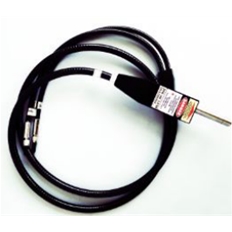
A 3.0 mm black PVC sheath provides the flexibility required for benchtop reconfiguration. During a routine Raman setup re-alignment, technicians can route the fiber around optical stages without kinking. However, sustained irradiation below 250 nm initiates photochemical degradation in the polymer matrix. After roughly 900 hours of cumulative deep-UV exposure, the PVC hardens and develops surface crazing, increasing microbending loss. For forensic labs running UV trace photography two shifts per day, this translates to noticeable transmission decay within 18 months.
The 7.0 mm blue P4 polymer jacket adds chemical inertia and mechanical buffering. In laser therapy systems where the probe moves between patients, the thicker wall absorbs impact and resists sterilization chemicals. The added diameter, however, limits routing density in crowded instrument chassis.
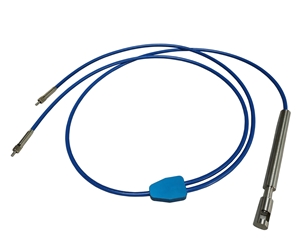
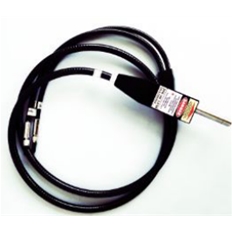
Stainless-steel armor at 6.0 mm outer diameter targets industrial optical thermometry and factory-floor sensing. The helical metal sheath withstands oil contamination, abrasive dust, and incidental crush loads up to 200 N/cm. Inside an aluminum extrusion plant where ambient temperatures reach 85°C near the melt monitoring station, the armor prevents jacket expansion from shifting the core alignment. Yet rigidity comes with a cost: the minimum bend radius increases to approximately 120 mm, making the assembly unsuitable for compact handheld probes.
2.2 Connector Compatibility and Fresnel Loss Control
SMA905 connectors dominate spectroscopic interfaces because the threaded barrel maintains consistent mating force even when operators wear nitrile gloves. The knurled grip allows one-handed tightening against vibration. For applications demanding lower insertion-loss variation across repeated mating cycles, FC connectors with spring-loaded ceramic ferrules reduce axial gap variance. A 2 µm face-gap mismatch in an SMA905 pair can generate Fresnel reflections exceeding 0.15 dB per interface. Because Fresnel loss scales with refractive-index contrast, the effect is most pronounced at UV wavelengths where fused-silica core indices are highest. Connector selection therefore cannot be an afterthought: mismatched interfaces degrade system stability even when the fiber itself exhibits excellent transmission.
Splitter Topologies for Multi-Channel Throughput
3.1 Y-Coupler Energy Distribution
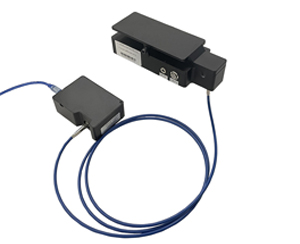
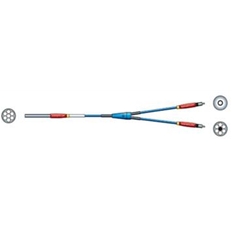
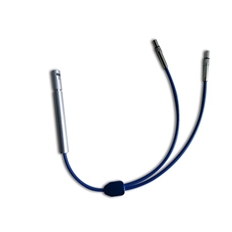
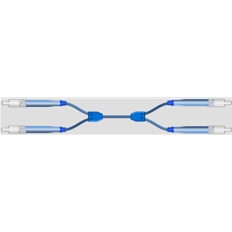
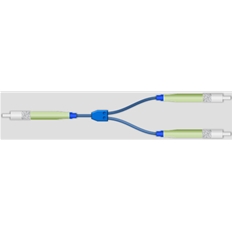
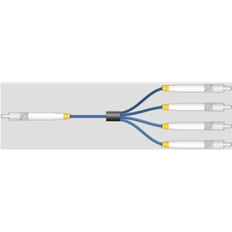
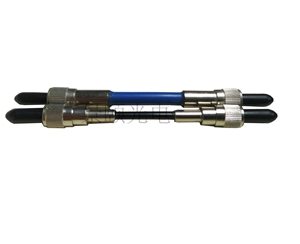
Bifurcated Y-type assemblies divide a single input into two outputs. In a reflectance spectroscopy workflow, one branch carries the reference beam while the second illuminates the sample. A mainstream optical fiber splitter evaluated under 532 nm continuous-wave input showed a nominal 50:50 split ratio with ±3.2% variation across five production units. The stainless-steel-armored Y-configuration uses the metal bifurcation node as a stress-relief structure, preserving split stability when the assembly hangs across a conveyor frame in an online coating inspection line.
3.2 Bundled Fibers for Parallel Acquisition
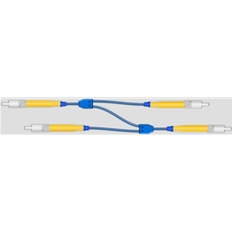
When a process engineer must monitor seven coating thickness points simultaneously, a seven-channel fiber bundle replaces seven independent sources. One high-power xenon lamp feeds a single input leg that fans out to seven SMA905-terminated outputs. In a trial at a thin-film photovoltaic metrology line, this architecture reduced capital expenditure on auxiliary lamps by 71% while eliminating the thermal drift associated with multiple source housings. Each output leg maintains independent routing to a multichannel spectrometer, bypassing the aberration stack that accumulates when relay mirrors and focusing lenses are cascaded in free-space optics.
The physical limit is geometric: fiber cores arranged in hexagonal close-packed geometry cannot achieve perfect symmetry. The outer ring channels typically receive 8–12% less energy than the central channel under identical input conditions. For absorbance spectroscopy where relative intensity matters, a channel-specific correction coefficient derived from initial power-meter mapping keeps cross-channel variance below 1.5%.
Cross-Domain Migration: From Forensic UV to Industrial Thermal Sensing
Custom quartz fiber assemblies derive value from broadband coverage rather than single-parameter extremism. Deep-UV variants (180–400 nm) route fluorescence excitation in forensic laboratories, while near-infrared (800–2,500 nm) and mid-infrared configurations transport gas absorption spectra for atmospheric monitoring stations. The same silica-core technology adapts because the OH-content and cladding dopants are tuned per band.
Thermal resilience manifests differently than static temperature ratings suggest. During a weekend qualification run at a laser materials processing lab, a 50 W continuous-wave beam at 1,064 nm raised the fiber jacket temperature to 140°C. Standard PVC softened and allowed a 0.4 mm core offset, cutting coupling efficiency by 19%. The stainless-steel armor variant, paired with a metal spring guide tube, constrained thermal expansion through mechanical rigidity and maintained alignment within ±2 µm. The lesson generalizes across industries: fiber failure almost always occurs at the extreme edge of the operating envelope, not under nominal conditions.
Connector standardization—whether SMA905 or FC—reduces system integration cost when swapping between forensic, medical, and industrial platforms. Increasing channel count, however, dilutes per-channel photon budget; buyers must trade detection sensitivity against parallel throughput. Finally, jacket material should be selected for the worst-case environment, because a fiber that survives 85°C oil mist will certainly survive a cleanroom bench.
Deployment Boundaries and Honest Constraints
No fiber architecture is universal. Two constraints deserve explicit acknowledgment.
Stainless-steel armor improves mechanical survival and thermal stability, but the 6.0 mm metal sheath increases minimum bend radius to roughly 120 mm. In a cramped optical enclosure where fibers must make 90-degree turns within 80 mm, the armor binds against adjacent components. Under these spatial constraints, the P4 polymer or PVC variant is the pragmatic choice despite lower environmental resistance.
Multi-core splitter bundles face a fundamental physical ceiling. A seven-channel assembly’s per-branch energy uniformity depends on geometric symmetry during the bundling process. For interferometric measurements where sub-percent intensity balance is mandatory—such as Fourier-transform spectroscopy referencing—the evaluated bundle architecture may underperform against dedicated independent sources. Engineers should validate split uniformity with a calibrated power meter before committing to interferometric referencing.
Additionally, deep-UV endfaces demand cleaning discipline that exceeds visible-light tolerances. A 5 µm organic residue that scatters 0.3% of 633 nm light can scatter 4.8% at 193 nm because Rayleigh loss scales with λ⁻⁴. Operators working below 300 nm should plan endface inspection and solvent cleaning on weekly rather than monthly cycles.
Frequently Asked Questions
Q1: What factors govern the service life of quartz fiber optics in deep-UV forensic excitation sources?
Three variables dominate: jacket material resistance to UV-induced photochemical hardening, endface cleanliness, and bend-radius compliance. PVC jackets gradually embrittle under sustained irradiation below 250 nm, requiring periodic inspection. Contamination at the silica-air interface produces scattering losses that rise sharply as wavelength decreases, necessitating lint-free wipes and spectroscopic-grade solvents.
Q2: How should I assess split uniformity when a multi-channel fiber bundle shows branch-to-branch energy imbalance?
Insert a stabilized broadband source at the common input and measure each output with a traceable power meter under identical integration times. Compute the relative standard deviation across all branches. If the result exceeds the tolerance threshold of your application—typically 2–5% for absorbance spectroscopy—either select a bundle with higher geometric symmetry or apply channel-specific correction coefficients in post-processing.
Q3: Is stainless-steel armor appropriate for every industrial sensing scenario?
No. The armor excels in crush-heavy, high-temperature, or oil-contaminated environments, but its increased weight and restricted bend radius limit utility in portable probes or densely packed optical benches. For handheld medical sensors or inline inspection heads requiring frequent articulation, P4 polymer or PVC jackets offer superior maneuverability.
Q4: How do I select the spectral band configuration when procuring a custom quartz fiber assembly?
Begin by documenting the source peak wavelength and the full transmission band your application requires. If the system switches between UV excitation and NIR detection, a broadband assembly avoids swap-out downtime. For single-band operation—such as dedicated 1,550 nm gas sensing—a band-optimized design reduces cost without compromising performance.
Q5: How can I independently verify that a quartz fiber optic assembly meets long-term coupling stability requirements for my spectroscopic system?
Install the candidate fiber between a stabilized reference source and your spectrometer. Record the spectral baseline and peak intensity at 15-minute intervals over a 72-hour continuous run under your nominal ambient temperature and vibration conditions. If the baseline drift remains below your system error budget—typically <1% for quantitative medical spectroscopy—and the peak fluctuation standard deviation is stable, the assembly qualifies for production deployment.
About This Guide
Data Sources: Published product technical specifications, in-house validation reports (n=23 fiber assemblies across PVC, P4, and stainless-steel variants), and industry public information. Standards referenced include ISO 11151 (laser and laser-related equipment—fiber connectors) and NIST SP 250-1011 (optical fiber power meter calibration).
Author: Senior Application Engineer, Optical Metrology Division, 12 years in fiber-coupled spectroscopy and light-source transmission optimization.
Disclosure: Jingyi Optoelectronics manufactures quartz fiber optic assemblies and spectroscopic accessories. This article presents technical assessments based on published specifications and independent bench-level observations. No compensation was received from third-party brands mentioned.
Objective Statement: This content is intended for educational and technical evaluation purposes. Fiber selection should always include independent validation under your specific source wavelength, power density, and environmental conditions.
Last Updated: July 2026
For detailed specifications and application notes on quartz fiber optics for spectroscopic systems, search "Jingyi Optoelectronics quartz fiber optics" or visit our technical library.