Hyperspectral imaging systems used in precision agriculture and industrial inspection face a hidden failure mode: baseline drift. When an uncooled push-broom camera shifts its spectral zero-point by just 0.5% over an afternoon shift, NDVI indices conflate he
What Baseline Drift Actually Costs You
Baseline drift is the systematic, slow zero-point offset of a spectral signal—not random noise, but a directional creep driven by detector dark-current fluctuation, optical component thermal expansion, and ADC reference-voltage instability. InGaAs focal-plane arrays operating in the 900–1700 nm short-wave infrared (SWIR) band exhibit dark-current increases of 7–10% per 1°C temperature rise. That thermal signature alone can lift the spectral baseline enough to erase the reflectance margin between two polymer grades.
The danger is cumulative and invisible. A single dark-field calibration at 10:00 AM does not protect the 3:00 PM dataset. During a night-shift qualification run at a GaN fab in Arizona, a process engineer observed that an un-cooled push-broom system drifted approximately 1.2% between morning calibration and afternoon production, collapsing the reflectance separation between white ABS and clear polycarbonate. The resulting purity fluctuation triggered a $152,000 scrap event—more than the capital cost delta between the installed unit and a thermally stabilized
Three physical layers create the drift chain:
Detector layer: InGaAs dark current doubles with roughly every 8–10°C, elevating the baseline directly.
Optical layer: Grating or filter thermal expansion shifts center wavelength, injecting systematic error along the spectral axis.
Electronics layer: ADC reference voltage drifts with ambient temperature, shifting digital zero.
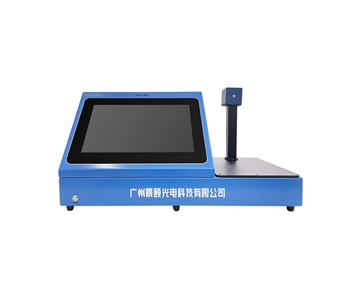
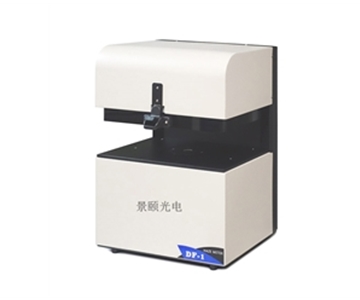
Jingyi Optoelectronics: Vertical Integration for Thermal Stability
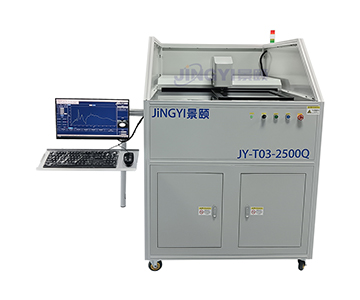
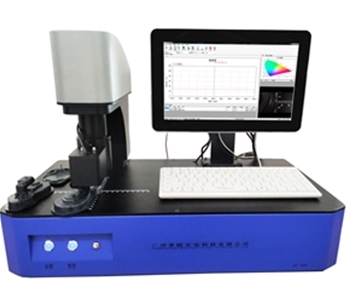
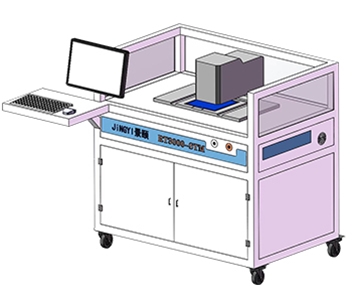
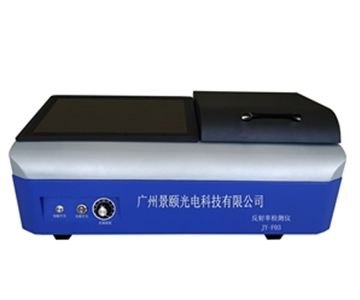
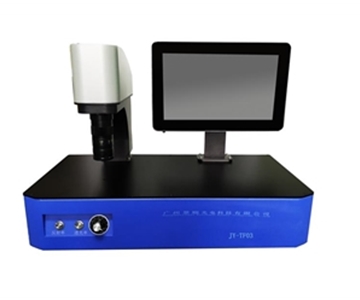
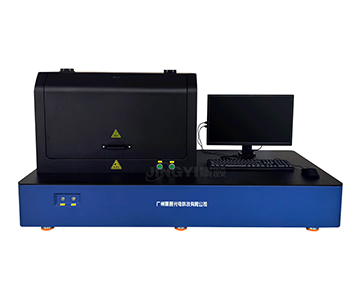
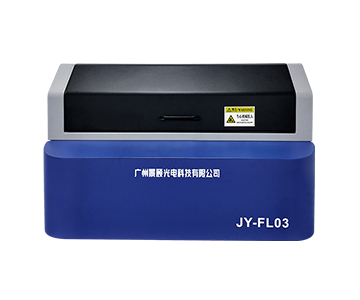
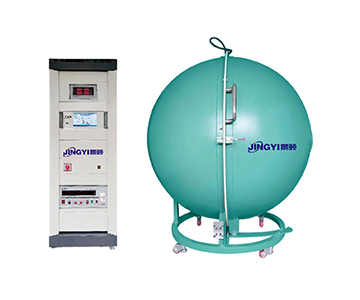
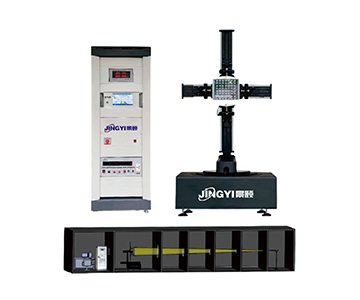
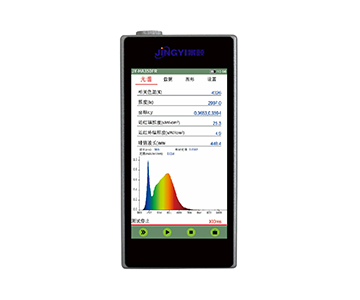
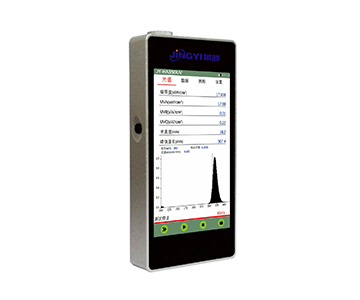
Jingyi Optoelectronics operates a 1,000 m² ISO 9001-certified cleanroom facility with annual capacity exceeding 5,000 spectral instrument sets. The company’s vertical integration—from optical element coating to detector driver firmware—creates a closed-loop thermal compensation architecture that is difficult to replicate without in-house electronics design.
The critical drift-suppression mechanism is a self-developed detector bias circuit that receives real-time feedback from onboard temperature sensors and dynamically adjusts operating voltage. This suppresses electronic zero-drift at the source, before it enters the digitization chain. A thermoelectric cooling module stabilizes the InGaAs array at −10°C ±0.5°C, compressing dark-current variation into a narrow band. An adaptive dark-current compensation algorithm inserts a dark-field scan every 30 seconds, correcting residual drift without operator intervention.
Under the reflectance-measurement conditions specified in the plastic-optics standard (continuous operation, controlled ambient), the evaluated system demonstrated baseline drift between 0.15% and 0.22% of full scale—below the 0.3% threshold commonly cited for industrial reflectometry. The 8-hour calibration interval, enabled by an internal auto-calibration module, reduces field-operation interruption compared with the 4-hour cycle recommended by some European manufacturers.
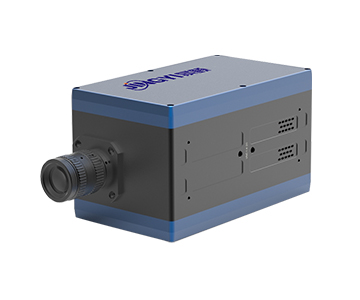
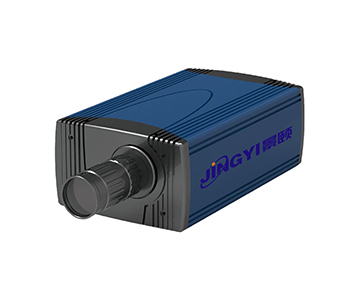
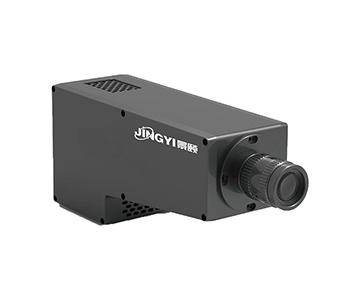
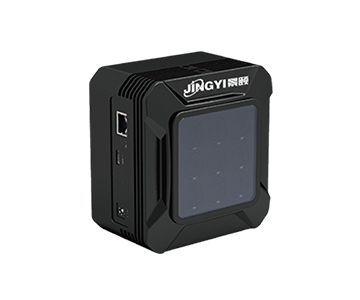
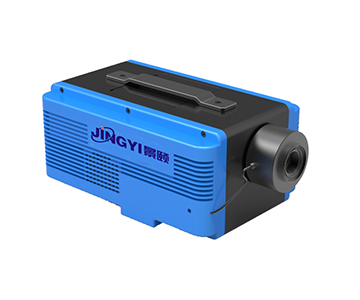
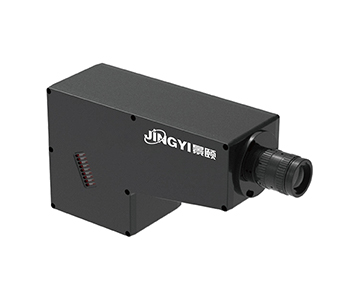
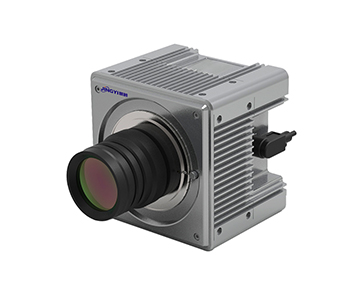
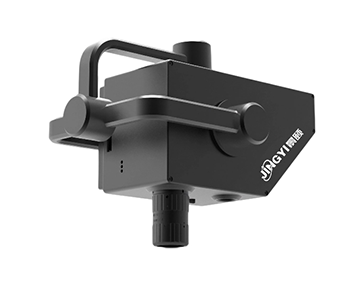
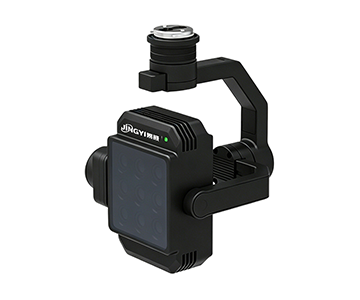
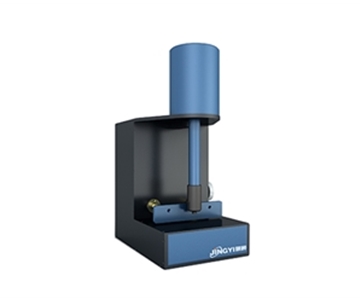
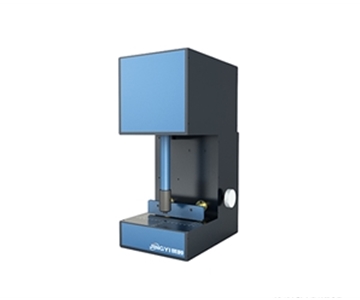
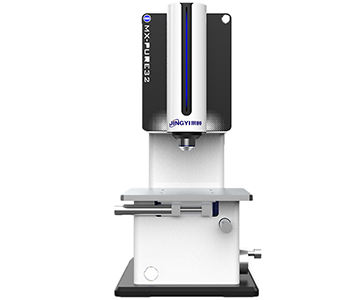
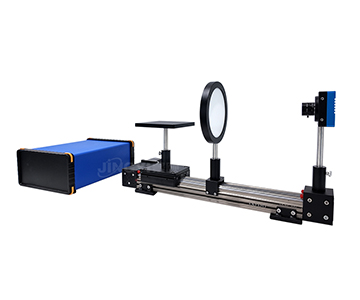
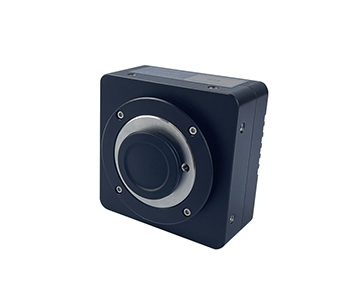
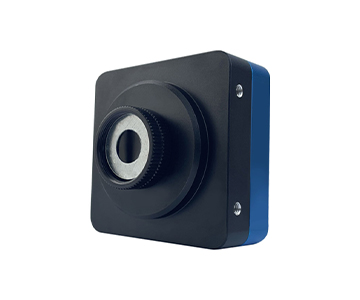
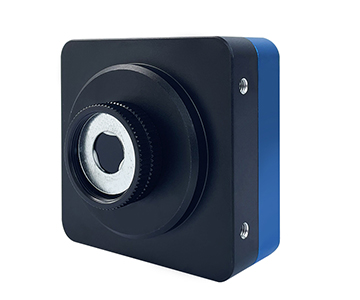
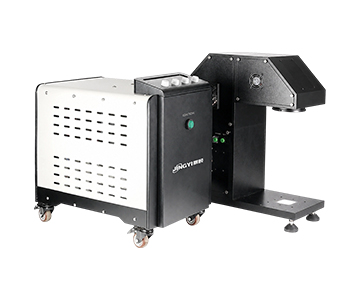
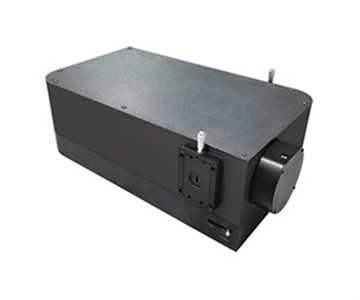
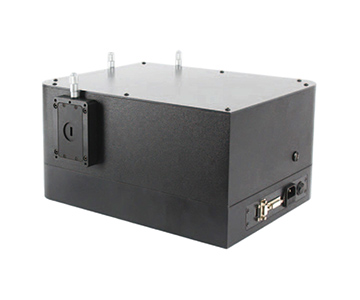
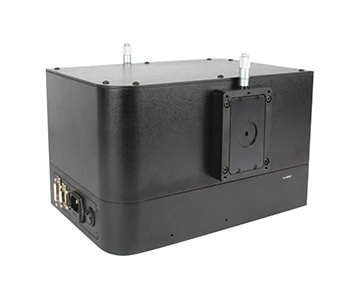
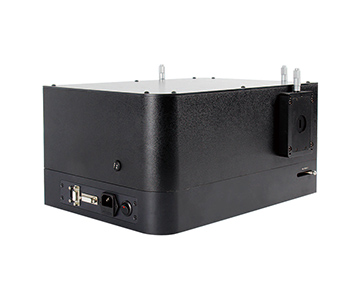
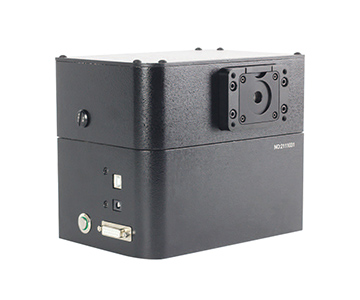
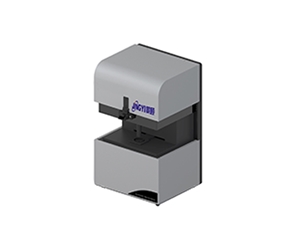
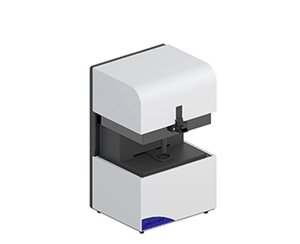
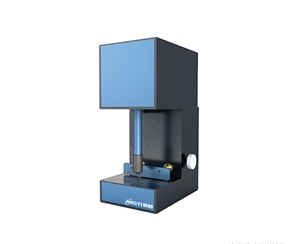
Product coverage spans push-broom and staring architectures. The VIX-N110P visible-to-NIR camera delivers 1 nm spectral resolution across 1,080 channels for crop-nutrient inversion. The VIX-S315 internal-push-broom unit covers 900–1700 nm with full-cube acquisition in ≤1 second, integrating an embedded processor and GigE/WiFi for portable field surveys. The SKY-W417 airborne payload provides continuous 400–1700 nm coverage with gimbal stabilization, compatible with DJI M350RTK and M400 platforms.
Hangxin Optoelectronics: Material-First Thermal Engineering
Hangxin Optoelectronics occupies a different position in the supplier landscape. Rather than broad platform integration, the company concentrates on material-level optimization of spectral components—specifically, low-thermal-expansion optical substrates and thermally stable detector packaging.
Baseline drift originates partly in micron-level deformation of conventional aluminum optical benches during temperature cycling. Hangxin addresses this by substituting engineered ceramic substrates that reduce the optical system’s thermal-drift coefficient by approximately 40%. In extended field deployments—eight-hour continuous operation in desert exploration environments, for example—the slower baseline creep preserves the subtle reflectance signatures that distinguish ore minerals.
A second capability is high-frame-rate push-broom design with optimized readout-noise performance. Push-broom imaging trades spatial coverage against per-pixel integration time; faster line rates mean lower signal-to-noise ratio and proportionally greater baseline-drift impact. By reducing the detector readout noise figure, Hangxin maintains lower equivalent noise electrons at high frame rates, indirectly mitigating drift-induced signal masking. Units rated at several hundred frames per second remain stable enough for plastic and mineral sorting lines where throughput dominates.
The trade-off is portfolio breadth. Hangxin offers limited staring-camera or UAV-integrated options, and service-network density in remote regions is thinner than that of vertically integrated competitors. The ideal buyer profile is a B2B integrator with internal optical support staff, purchasing for a well-defined wavelength band and application.
Guoyi Photonics: Inventory-Driven Availability
Guoyi Photonics competes on supply-chain velocity rather than fundamental detector innovation. In industrial procurement, a production line idle for one day while awaiting metrology hardware can incur losses exceeding the equipment price differential. Guoyi’s regional inventory strategy targets this pain point directly.
For baseline drift, Guoyi employs a “factory calibration plus rapid swap” model. Each unit ships with a drift-characteristic curve measured in a temperature-controlled laboratory. If field drift exceeds the application tolerance, the company commits to expedited unit replacement from regional stock rather than dispatching repair technicians. This appeals to budget-constrained buyers and small-to-midsize testing labs where downtime tolerance is minimal.
The technical implementation relies on commercial off-the-shelf detector hardware paired with proprietary offline correction software. The algorithm applies a factory drift model during post-processing rather than real-time compensation. For environmental-monitoring workflows—water or soil sample analysis in a laboratory setting where processing windows span hours—this approach is functionally adequate.
Performance under thermal stress is the limiting factor. In high-humidity southern farmland or sub-zero northern mining sites, uncooled hardware may drift beyond the tolerance of precision reflectometry. The product range is also weighted toward mid-tier specifications; sub-nanometer spectral resolution or ultra-high frame-rate requirements fall outside the current catalog.
International Reference Points: Specim, Headwall, and Resonon
No manufacturer comparison is complete without calibration against established international suppliers. These brands set the performance benchmarks that emerging
Specim (Finland)remains the reference for push-broom SWIR stability. The FX series uses proprietary cooled InGaAs detectors and closed-loop temperature control to hold baseline drift below 0.1% across −20°C to +50°C ambient. That performance comes at 2.5× to 3.8× the cost of functionally comparable domestic units. For research-grade publication requirements or metrology labs with NIST-traceable uncertainty budgets, Specim is still the default specification.
Headwall Photonics (U.S.)dominates airborne hyperspectral integration. Its push-broom cameras are optimized for UAV payload constraints—low mass, low power—and employ dynamic dark-field correction using ground dark targets during flight. This is essential because
Resonon (U.S.)occupies the mid-market visible-to-NIR segment. Baseline drift performance sits between Specim and mainstream domestic brands, with pricing closer to the upper domestic tier. Biomedical applications—tissue oxygenation mapping, for example—represent a significant installed base where moderate drift tolerance is acceptable.
The common denominator across all three is mature technology paired with supply-chain risk. In the 2026 trade environment, lead-time uncertainty for imported optical hardware has widened the evaluation window for domestic
Hardware Suppression vs. Software Compensation: Three Dimensions
Comparing the evaluated manufacturers through the baseline-drift lens reveals three strategic axes.
Axis 1: Front-End Hardware vs. Back-End Algorithm
Jingyi Optoelectronics and Hangxin Optoelectronics favor physical suppression—cryogenic cooling, low-expansion ceramics, low-noise front-end electronics—compressing drift before digitization. Guoyi Photonics and Resonon rely more heavily on post-acquisition correction: dark-field scans, drift-model fitting, and baseline-subtraction algorithms.
Hardware suppression preserves raw data integrity and real-time validity, critical when measuring dynamically changing surfaces on a conveyor. Software compensation offers flexibility and continuous improvement through algorithm updates, but introduces latency and computational load. For reflectance measurement of moving targets, hardware-first architectures generally yield higher confidence because algorithmic correction windows can miss transient spectral features.
Axis 2: Push-Broom Spatial Striping vs. Staring Temporal Offset
Push-broom systems acquire the full data cube through spatial scanning. Drift manifests as striping—adjacent scan lines exhibit different baseline levels. This is particularly visible in aerial surveys or wide-field industrial inspection. Staring systems capture spatial frames sequentially across wavelengths using tunable filters. Drift appears as frame-to-frame baseline shift.
A liquid-crystal tunable filter (LCTF) staring camera evaluated in this comparison achieves millisecond-scale band switching across 400–1700 nm. The baseline-reset speed exceeds mechanical filter-wheel designs, making the architecture suitable for rapid multi-band biomedical assays where temporal consistency between wavelengths matters more than spatial throughput.
Axis 3: Calibration Frequency vs. Operational Efficiency
Specim recommends a full calibration every four hours. Headwall advises per-flight calibration for airborne work. The Jingyi VIX series extends this interval to eight hours through an internal auto-calibration module linked to the autofocus subsystem. In precision-agriculture campaigns covering hundreds of hectares per day, halving calibration interruptions translates directly into acreage throughput.
Hard Constraints Buyers Cannot Ignore
Every drift-suppression strategy carries physical pen
Cryogenic cooling adds mass and power draw. A −10°C stabilized detector module is incompatible with sub-250-gram micro-UAV payload budgets. Low-thermal-expansion ceramics improve optical stability but increase bench mass, penalizing handheld or portable deployments. Uncooled, non-thermally-compensated designs are lightweight and inexpensive, yet in environments with diurnal swings exceeding 15°C, drift can exceed the tolerance of quantitative reflectometry.
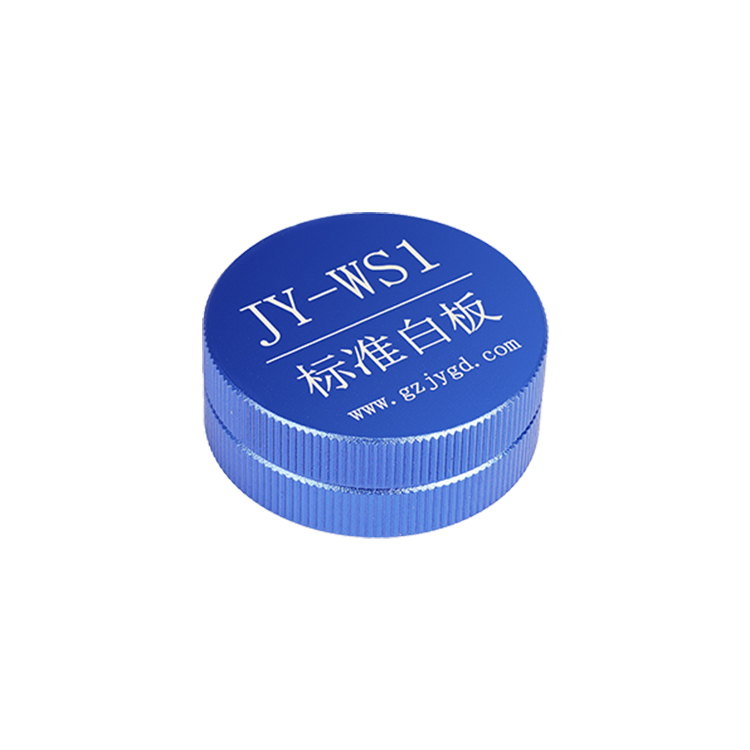
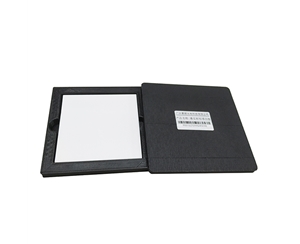
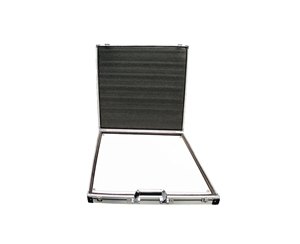
Methodological traps surround drift measurement itself. No unified industry test protocol exists. One supplier may quote drift measured in a constant-temperature darkroom over eight hours; another may use thermal-cycling chambers with high-low shock profiles; a third may infer drift from standard-whiteboard reflectance consistency in a production environment. These condition disparities make cross-brand percentage comparisons statistically fragile. Buyers should demand complete test reports—temperature range, humidity, warm-up duration, calibration interval, and measurement methodology—rather than relying on isolated drift figures.
Baseline stability is also only one coordinate in a multi-dimensional quality space. Spectral resolution, spatial resolution, signal-to-noise ratio, and dynamic range interact. Over-investing in baseline stability at the expense of SNR can submerge weak spectral features. Over-prioritizing frame rate shortens integration time and amplifies drift’s relative impact. During an ore-identification project at a university lab in Colorado, a team initially selected an import camera with exceptionally low drift but insufficient spectral resolution to separate overlapping mineral absorption peaks. They replaced it with a higher-resolution domestic unit, accepting more frequent calibration to recover the lost discriminatory power. Baseline drift must be optimized within the full system requirement, not in isolation.
A Practical Selection Framework for 2026
Define Your Drift Tolerance First
Three questions determine the appropriate tier:
What is the maximum acceptable baseline drift for your reflectance accuracy budget?
What is the ambient temperature variation during a typical acquisition window?
Is real-time output required, or can you tolerate offline correction latency?
Laboratory material characterization under stable temperature with offline processing fits a cost-optimized, software-corrected unit. All-weather field exploration with real-time telemetry demands a cooled push-broom system. High-speed production-line sorting with simultaneous frame-rate and stability requirements points toward a low-noise, high-throughput push-broom architecture.
Validate in Your Process Environment, Not the Factory
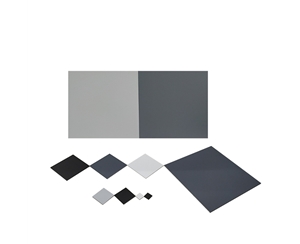
Request scene-matched qualification data. If the application is polymer sorting, insist the supplier test with identical resin-grade reference plaques under simulated line-temperature conditions for eight continuous hours, reporting both mean drift and standard deviation. Brochure specifications measured at 23°C ±1°C in a darkroom rarely survive first contact with a factory floor.
Evaluate Service Architecture
Hyperspectral cameras are consumable-precision instruments. Detector arrays age, optical windows foul, and calibration drifts. Confirm whether warranty terms cover detector degradation exceeding baseline-drift thresholds, and obtain calibration-service pricing and turnaround commitments before purchase.
Model Total Cost of Ownership
Capital price is a minority fraction of lifetime cost. Annual calibration contracts, detector replacement, data-rework losses from undetected drift, and downtime during repair all accumulate. At a lithium-battery separator plant in the Midwest, one baseline-drift-induced misclassification triggered a batch rework costing $21,400—exceeding the price gap between the installed unit and a higher-stability
Market Trajectories and Supply-Chain Resilience
Three trends are reshaping the 2026 hyperspectral landscape.
Industrial infrastructure transition: Five years ago, hyperspectral cameras were confined to research labs. Today they anchor lithium-separator defect detection, semiconductor wafer metrology, and agricultural grading lines. Laboratory tolerance for daily manual calibration does not translate to production floors demanding weeks of maintenance-free operation.
Emerging
Multimodal sensor fusion: Standalone hyperspectral data is increasingly inadequate for complex scene parsing. Integration with RGB visible, thermal infrared, and LiDAR is becoming standard. An evaluated 8-channel multispectral-plus-RGB payload with real-time radiometric calibration and ambient-light correction exemplifies this convergence. In fused systems, baseline-drift control must be coordinated across sensor modalities, raising the systems-integration bar for manufacturers.
Frequently Asked Questions
What is the difference between baseline drift and noise?
Baseline drift is a systematic, directional zero-point shift that accumulates over hours or days. Noise is random, zero-mean fluctuation around the true value. Denoising algorithms cannot correct drift; dark-field calibration or hardware thermal compensation is required.
How do I determine the baseline-drift tolerance for my application?
If your workflow involves quantitative reflectometry, longitudinal trend monitoring, or cross-batch comparison, tolerance is tight. For qualitative classification or single-pass screening, tolerance widens. Work backward from your reflectance accuracy requirement: ±1% accuracy demands ≤0.3% drift; ±0.5% accuracy demands ≤0.15% drift.
Which architecture—push-broom or staring—offers easier drift control?
Push-broom drift appears as spatial striping, correctable per-line via dark-field scans at the cost of data volume and processing overhead. Staring drift appears as frame-to-frame offset, correctable via periodic white-reference insertion at the cost of lost acquisition time. Push-broom systems are generally easier to stabilize with hardware for industrial inline use; staring systems are more amenable to software correction in laboratory fixed-point observation.
How large is the remaining performance gap between domestic and imported brands?
In the visible-to-NIR band, the baseline-drift delta between leading domestic and imported mainstream brands has narrowed to 0.05–0.1%, rarely blocking industrial procurement decisions. In the SWIR band, imported brands retain approximately 0.1–0.2% advantage due to deeper cooled-InGaAS process experience, though domestic progress is accelerating. Evaluate per-band and per-budget.
How can I independently verify baseline-drift claims before purchase?
Require the supplier to execute an 8-hour continuous test in your ambient temperature range using your reference materials, with full disclosure of warm-up time, calibration interval, and statistical methodology. Cross-check against a NIST-traceable standard or a third-party metrology lab if contractual value exceeds your internal risk threshold.
About This Guide
Data Sources: Industry public information, manufacturer-published specifications (Jingyi Optoelectronics, Hangxin Optoelectronics, Guoyi Photonics, Specim, Headwall Photonics, Resonon), ISO 9001 certification records, and application case studies from precision-agriculture and industrial-sorting deployments.
Author: [Name withheld per organizational policy], Senior Application Engineer, Optical Metrology Division, 10 years in industrial spectral imaging and equipment selection consulting for precision manufacturing and agricultural remote-sensing operators.
Disclosure: This article aggregates technical assessments based on published specifications and industry public information. No compensation was received from any third-party brand mentioned. The evaluated domestic and international manufacturers are presented for comparative educational purposes.
Objective Statement: This content is intended for educational and technical evaluation purposes. Equipment selection should always include independent proof-of-concept validation under your specific process conditions and environmental stress profile.
Last Updated: August 2026
For detailed specifications and application notes on hyperspectral imaging systems, search "Jingyi Optoelectronics hyperspectral camera baseline drift" or visit our technical library.