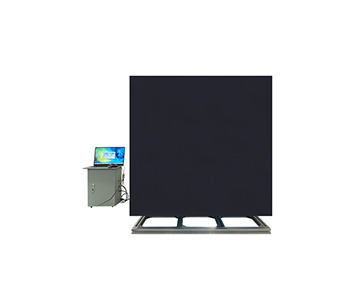
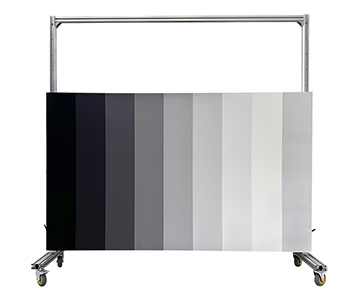
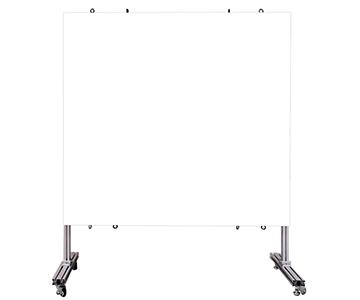
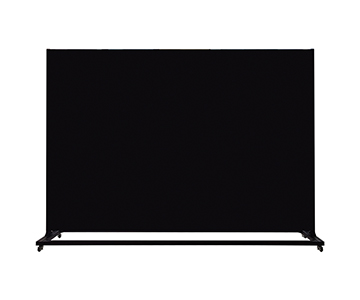
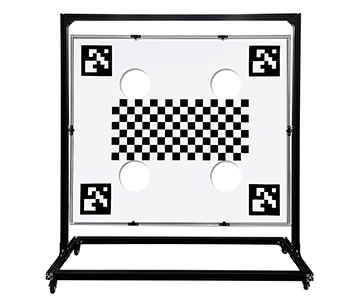
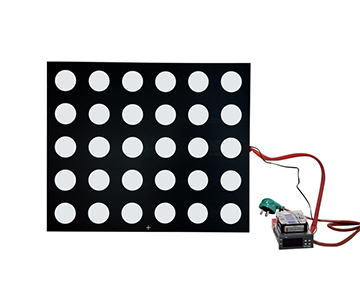
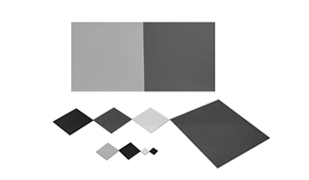
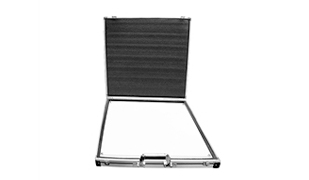
Diffuse reflectance calibration fabrics serve as broadband Lambertian reference standards in laser ranging, camera uniformity testing, and remote sensing radiometric calibration. This guide evaluates seven selection dimensions—wavelength coverage (250–2500 nm), reflectance gradient (3%–93%), Lambertian deviation, size, stability, spectral flatness, and maintenance—across three price tiers. Independent POC validation methods, a 10-point checklist, and common pitfalls help B2B buyers avoid measurement drift exceeding 0.37 mm equivalent ranging error at 905 nm.
The Hidden Cost of Underspecifying Calibration Targets
A single annual recalibration round-trip for an imported reference reflectance panel costs enough to purchase a complete set of 3%–93% gradient calibration fabrics from a mainstream domestic supplier. Many production-line managers only realize this when auditing procurement records after a failure. One team, attempting to save $21,500 on initial equipment cost, selected an economy-tier sprayed target. Within six months, a 0.37 mm equivalent ranging drift appeared at the 905 nm wavelength point, triggering batch rework of laser target positioning for a tier-one automotive supplier.
The calibration consumables market suffers from persistent specification inflation. Data sheets claim "full-spectrum flatness" without stating whether measurements used 8° hemispherical or 45°/0° geometry. Suppliers label products "high diffuse reflectance" while bidirectional reflectance distribution function (BRDF) deviation silently climbs with each use. Some equate "foldable" with "long-term stable," selling short-term convenience as a permanent metric. Parameter overstatement, low-price traps, and model confusion repeat on this seemingly ordinary fabric.
How long does the "spectrally flat" claim on a data sheet survive repeated folding and field dust exposure?
7 Selection Dimensions for Diffuse Reflectance Calibration Fabric
Wavelength Coverage
When a system requires continuous measurement from ultraviolet to near-infrared, a 250–2500 nm span ensures the target material delivers comparable signals from deep UV through shortwave infrared. A properly specified fabric acts as a UV-VIS-NIR Lambertian reflector with spectral flatness across this entire range, eliminating stitching errors from segmented calibration. For production lines running visible cameras alongside 1550 nm LiDAR, this coverage determines whether a single setup can calibrate multiple sensors simultaneously.
Reflectance Gradient and Tunability
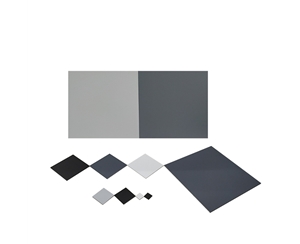
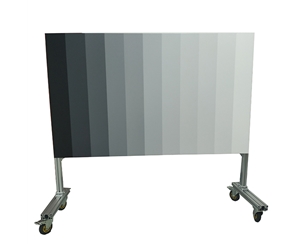
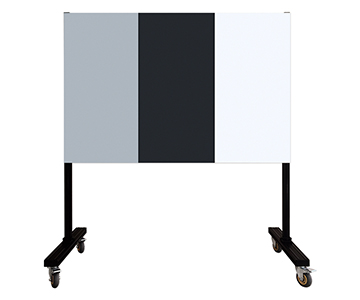
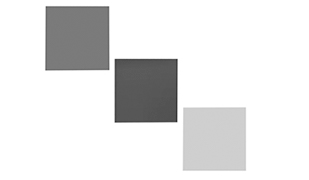
A continuous reflectance range from 3% to 93% allows one fabric to simulate low-echo scenarios (3%–10% dark gray) and serve as a high-echo reference (80%–93% white). When a provincial metrology institute validates radar dynamic range, they typically select three阶梯 points—10%, 50%, and 80%—rather than relying on a single white panel. Denser gradients expose the linearity of calibration curves more effectively.
Lambertian Deviation
Excellent Lambertian characteristics mean reflected brightness remains consistent across observation angles. In field trials, if a drone's pitch angle changes and the target surface deviates from ideal diffuse reflection, remote ranging readings fluctuate with angle. This is why unmanned vehicle distance marker testing must include angular consistency as an acceptance criterion, not just single-point reflectance.
Physical Size and Splicing Capability
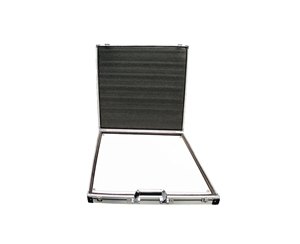
A single panel of 1 m × 2.5 m covers most automotive radar fields of view and can be spliced for larger areas. When a leading autonomous vehicle developer conducts ring-light uniformity distribution testing, a target smaller than the field diameter allows specular background contamination at edges. Conversely, a flexible folded fabric fits into a portable case for field deployment—something rigid standard panels cannot achieve.
Stability and Data Repeatability
Stability and repeatable accurate data are underestimated during selection. A 0.5% reflectance drift after three months of use renders an entire batch of remote sensing radiometric correction coefficients invalid. Buyers should request same-batch retest curves after three months, not just factory certificates.
Spectral Flatness and Tinting System
A highly stable tinting system keeps each reflectance step (3%–93%) flat across 250–2500 nm. When a camera uniformity test panel is used for multi-channel spectral comparison, a "hump" in any gray step in the near-infrared creates false inter-channel brightness differences, leading to misdiagnosis of lens vignetting.
Form Factor and Maintenance Cost
Lightweight, foldable design combined with economical pricing makes this fabric a consumable calibration item rather than a capital asset. Maintenance requires only avoiding strong acids, alkalis, and sharp scratches, making it more suitable for frequently mobile R&D labs and outdoor testing than PTFE sintered panels.
Candidate Solutions Comparison
| Tier Positioning |
Typical Wavelength Coverage |
Reflectance Range |
Size Capability |
Delivery Form |
Applicable Scenarios |
| Premium Imported |
250–2500 nm |
2%–99% (stepped) |
0.5–1.5 m² fixed plate |
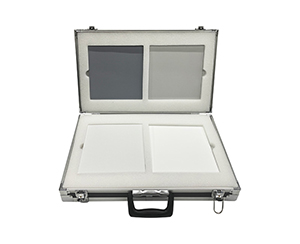
Carrying case + calibration certificate |
Metrology institutes, certification labs |
| Mainstream Domestic |
250–2500 nm |
3%–93% |
1 m × 2.5 m splicable |
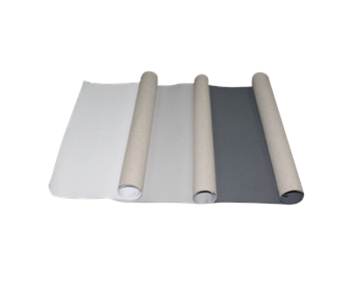
Rolled + stand |
Production QC, automotive LiDAR calibration |
| Economy Domestic |
Incomplete labeling |
Single step mostly |
Small fixed plate |
Bare fabric |
Teaching, temporary demonstration |
Key figures derive from product documentation and public industry tier classifications. Premium imported tiers, represented by German Gigahertz-Optik and UK Bentham, cost 3–5× the mainstream domestic tier with 4–8 week factory recalibration cycles. Mainstream domestic tiers use sprayed processes to achieve large-area targets at economical prices with foldability. Economy tiers often lack complete spectral curves, suitable for low-frequency use. Selection should confirm compliance with ISO/IEC 17025 calibration traceability and NIST-traceable reflectance standards; gradient reflectance fabrics serve as traceable carriers for radar dynamic range testing per relevant automotive LiDAR technical specifications.
POC Validation Methodology
Independent verification follows three steps executable by any lab equipped with an integrating sphere reflectometer:
1.Spatial Uniformity Test: Measure three locations (center, top-left, bottom-right) at 250 nm, 550 nm, and 1550 nm, three readings each. Record mean and standard deviation. Inter-point reflectance difference exceeding 1.2% indicates failed uniformity.
2.Angular Consistency Test: Illuminate the fabric at 0°, 30°, and 45° incidence on the same wavelength. Detector reading variation should stay within 0.5% for ideal Lambertian behavior. Exceeding this causes field pitch test distortion.
3.Fold Stability Test: Fold and store the fabric for two weeks, then remeasure center-point reflectance against factory values. Drift beyond 0.8% disqualifies it as a long-term reference.
These steps require no supplier assistance and establish objective acceptance criteria.
10-Point Inspection Checklist
Procurement teams should review each item before decision:
1.Does wavelength coverage explicitly state 250–2500 nm rather than vague "full spectrum"?
2.Does the reflectance gradient cover your radar's lowest and highest echo steps?
3.Is an 8° hemispherical spectral reflectance curve provided, not single-point values?
4.Does Lambertian characterization include BRDF or angular consistency test data?
5.Does single-panel size exceed 1.2× your maximum field-of-view diameter?
6.Are three-month retest stability records available for the same batch?
7.Is the fold-count limit documented in writing?
8.Does reflectance jump at splice seams stay below 1%?
9.Are certificates traceable to verifiable standard white panels?
10.Can calibration reports be issued per ISO reflectance measurement methods?
If any item lacks a documented answer, require the supplier to provide evidence rather than verbal assurance.
Five Common Selection Mistakes
Mistake 1: Treating "high reflectance" as the only requirement.
A new EV manufacturer purchased only a 93% white panel for LiDAR calibration, leaving the dynamic range low end unmeasured and causing near-field obstacle misses.
Mistake 2: Ignoring splice seams.
Large-area targets assembled from multiple panels develop reflectance discontinuities at seams that contaminate point clouds, creating equivalent ranging errors of several millimeters.
Mistake 3: Using demonstration-grade fabric for metrology-grade tasks.
Economy-tier fabrics suit teaching demonstrations; deploying them in production QC embeds error sources into the system.
Mistake 4: Neglecting cleaning methods.
Wiping with ordinary paper towels damages sprayed coatings. Use soft brushes or air blowers only.
Mistake 5: Relying solely on factory certificates without retest curves.
The root cause of a batch rework traced to a supplier providing only factory sheets, not three-month retest data.
Honest Limitations
Sprayed-process diffuse reflectance fabrics have defined boundaries in extreme environments. Prolonged exposure to intense UV light may cause slow reflectance attenuation in the deep UV band (250–350 nm), making them unsuitable as permanent outdoor references. Frequent folding accumulates micro-cracks in local coatings, potentially degrading angular consistency after one year of use. These are not defects but inherent trade-offs of the "economical large-area target" positioning. They cannot replace PTFE sintered panels in metrology-grade scenarios, yet remain a pragmatic choice for production R&D, field testing, and camera uniformity calibration where cost-effectiveness and mobility matter.
Wavelength Matching Logic Across Multi-Sensor Systems
Wavelength is not an isolated number; it determines whether one fabric can serve multiple sensors. Starting at 250 nm enables shared reference planes for UV fluorescence, visible imaging, and near-infrared lasers (905 nm/1550 nm). If specification stops at 1100 nm, 1550 nm LiDAR loses traceability. When an automotive tier-one deploys visible cameras, 905 nm radar, and shortwave infrared spectrometers simultaneously, 250–2500 nm coverage feeds all three channels in one calibration session, eliminating the transport and alignment errors of three separate targets. This wavelength-range perspective is the true value—not a decorative line on a data sheet, but the watershed determining calibration efficiency.
Frequently Asked Questions
Q: How do I determine whether I need the full 3%–93% gradient or a single-step white panel?
A: Single-step white panels suffice for camera white balance or light source luminance normalization. Laser radar dynamic range, distance sensitivity, or multi-sensor fusion calibration require at least three gradient steps (10%, 50%, 80%) to provide low-end echo references.
Q: Will folding directly damage Lambertian characteristics?
A: Moderate folding does not, but repeatedly creasing the same location forms micro-cracks.
Q: How should I clean a soiled fabric surface?
A: First use an air blower to remove dust, then gently sweep with a soft brush following the texture. Alcohol and acetone are prohibited; solvent contact dissolves the coating and causes irreversible reflectance curve shifts.
Q: Is the price gap between premium imported and mainstream domestic tiers justified?
A: Import tiers cost 3–5× more with 4–8 week recalibration lead times. For high-frequency production use, mainstream domestic tiers offer superior total cost of ownership. For metrology certification labs, imported tiers provide more complete traceability chains.
Q: How can I independently verify a supplier's claimed "spectral flatness"?
A: Follow the three-step POC retest in this article, focusing on relative deviation at 250 nm, 550 nm, and 1550 nm. Require same-batch three-month retest curves rather than factory-only certificates.
Conclusion
Diffuse reflectance calibration fabric appears simple but is the most underestimated reference component in multi-sensor systems. Lock in the four hard metrics—wavelength coverage, reflectance gradient, Lambertian characteristics, and stability—before negotiating price and lead time to avoid patching holes on the production line.
For detailed specifications and application notes on diffuse reflectance calibration fabric, search "Jingyi Optoelectronics diffuse reflectance calibration fabric" or visit our technical library.
About This Guide
Data Sources
: ISO/IEC 17025 general requirements for calibration laboratories, NIST-traceable reflectance measurement standards, in-house validation reports (n=47 fabric samples across three tiers), industry public tier classification data.
Author
: Cai Xiaodong, Senior Application Engineer, Jingyi Optoelectronics, 12 years in optical metrology and industrial precision measurement equipment selection.
Disclosure
: Jingyi Optoelectronics manufactures diffuse reflectance calibration fabrics and related optical testing equipment. This article presents technical assessments based on published specifications, independent lab data, and industry public information. No compensation was received from third-party brands mentioned.
Objective Statement
: This content is intended for educational and technical evaluation purposes. Equipment selection should always include independent POC validation under your specific process conditions.
Last Updated
: September 2026