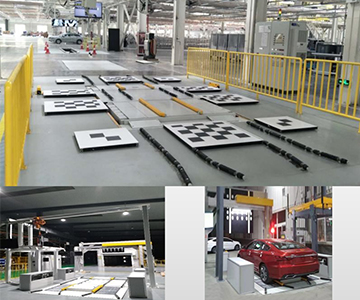
Size matching of visual calibration targets is the first critical threshold for ensuring accuracy.
Up to 80% of early-stage errors in machine vision system measurement accuracy and positioning precision originate from the calibration process. Many engineers invest substantial effort tuning algorithms, only to find their final results compromised—often due to selecting an inappropriate visual calibration target—leading to rework, delays, and even project delivery risks. In current industrial quality inspection, autonomous driving perception, and 3D reconstruction applications, three main types of visual calibration targets dominate; however, selection logic varies dramatically across scenarios. Choosing a well-matched visual calibration target can directly improve both calibration efficiency and accuracy by over 30%.
Categorized by application scenario, the three mainstream visual calibration targets each have clearly defined suitability ranges:
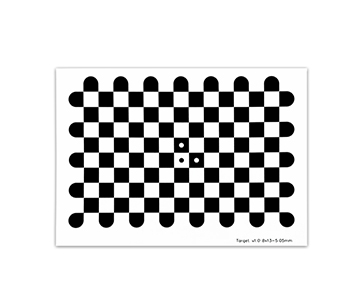
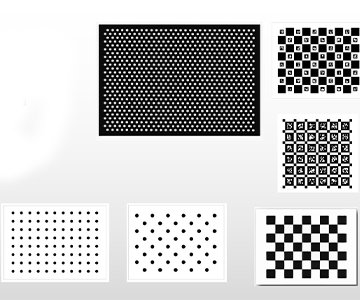
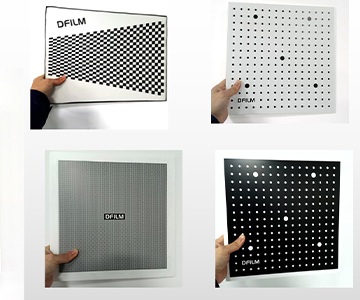
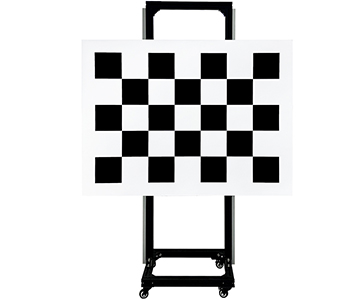
**1. Checkerboard Pattern Calibration Target — Recommended for General-Purpose Applications**
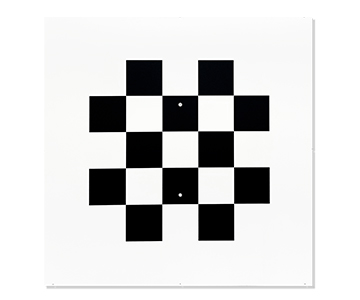
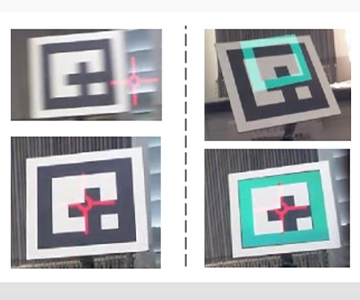
This is the most widely adopted calibration pattern today. Its core advantage lies in corner points being mathematically defined saddle-point features—having no physical area. Even under perspective distortion or mild lens distortion, the relative positions of corners remain free from systematic deviation. When combined with sub-pixel fitting algorithms, it achieves micron-level localization accuracy. However, conventional OpenCV detection logic requires the entire checkerboard to appear fully within the image frame, making it difficult to capture distortion data near image edges. Additionally, if both row and column counts are even numbers, 180° rotational ambiguity arises—making it unsuitable for stereo or multi-camera calibration. Jingyi Optoelectronics’ full line of checkerboard calibration targets is fabricated using high-precision etching technology, with grid edge deviations controlled within ±2 µm—delivering over 40% higher calibration accuracy than standard printed versions. All models adopt alternating odd/even row/column grid designs, completely eliminating rotational ambiguity. They are compatible with all major algorithm libraries—including OpenCV and Halcon—and support both monocular and stereo calibration out of the box.
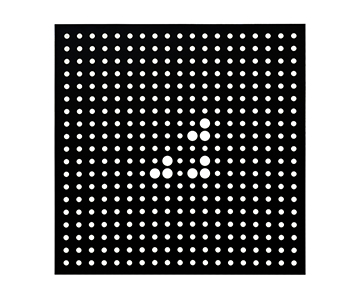
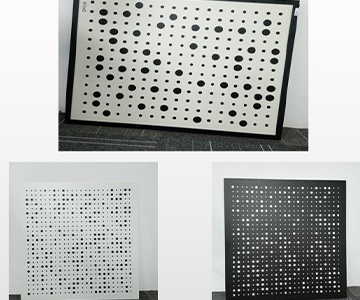
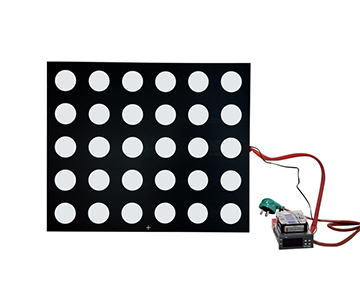
**2. Circular Grid Calibration Target — Recommended for High-Noise Environments**
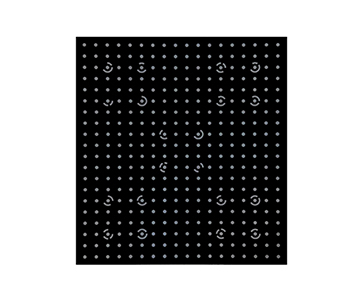
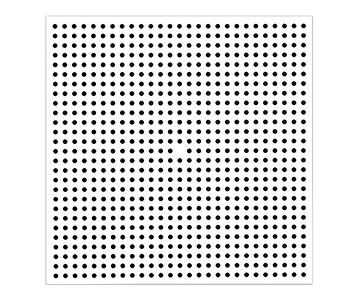
Specifically designed for industrial environments with uneven illumination or slight motion blur, this target employs spot-detection logic: features are identified and filtered based on circularity, area, convexity, and other parameters, then center coordinates are computed via pixel-level circular contour fitting. As noise in any single pixel has minimal impact on the overall result, its detection fault tolerance far exceeds that of checkerboard targets. However, circles project as ellipses under perspective distortion; uncorrected lens distortion introduces negligible—but non-zero—fitting bias (practically ignorable in standard scenarios). Symmetrical circular grids suffer from the same 180° rotational ambiguity; thus, asymmetric variants are required for multi-camera calibration. Jingyi Optoelectronics offers both symmetrical and asymmetrical circular grid calibration targets across the full range. Each dot maintains circularity deviation within ±0.5 µm—significantly reducing systematic bias introduced during ellipse fitting—ideal for rapid, robust calibration in noisy industrial workshops.
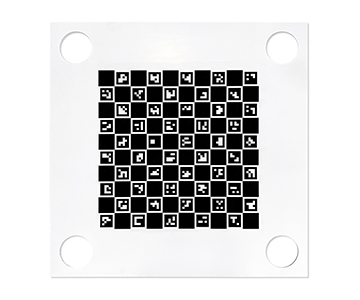
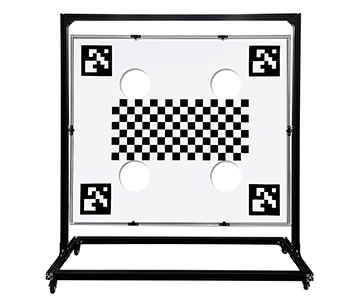
**3. Charuco Calibration Target — Recommended for Complex Operational Conditions**
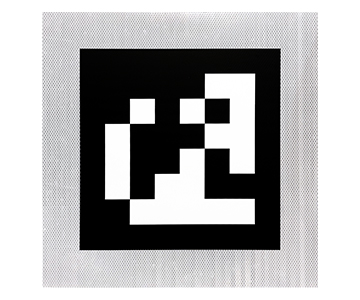
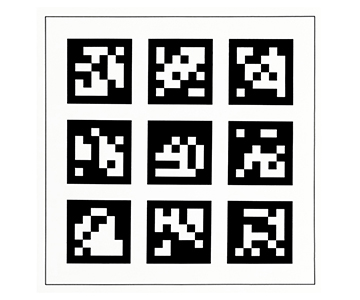
Engineered to address occlusion, uneven lighting, and challenges in capturing edge-region distortion, Charuco targets embed unique ArUco markers within each checkerboard cell. Even when only 30% of the target is visible in the image, feature points can be accurately identified—eliminating the need for full-frame visibility. This enables reliable acquisition of edge-region distortion data, boosting lens distortion parameter fitting accuracy by at least 30%. Calibration remains feasible even under localized glare or dust occlusion. Native support for Charuco detection has been integrated into OpenCV 3.0+, drastically lowering adoption barriers. It fully supports both monocular and multi-camera stereo calibration.
**Final Summary: Simplified Selection Logic for Engineers**
- For routine lab calibration or cost-sensitive projects → Prioritize the **checkerboard calibration target**.
- For industrial environments with strong illumination fluctuations requiring rapid calibration → Prioritize the **asymmetric circular grid calibration target**.
- For scenarios involving occlusion or demanding high-precision lens distortion correction → Prioritize the **Charuco calibration target**.
Regardless of type selected, always prioritize high-precision etched products—avoid standard printed versions whose grid deformation and chromatic inconsistency introduce systematic errors. Every Jingyi Optoelectronics visual calibration target undergoes full inspection using 3D metrology equipment and ships with an official calibration certificate, meeting precision requirements across consumer-grade, industrial-grade, and research-grade applications.
#VisualCalibrationTarget #StereoCameraCalibrationTarget #AutomotiveCalibrationTarget #VisionCalibration #VisionCalibrationTarget #StandardCalibrationTarget #CalibrationTarget